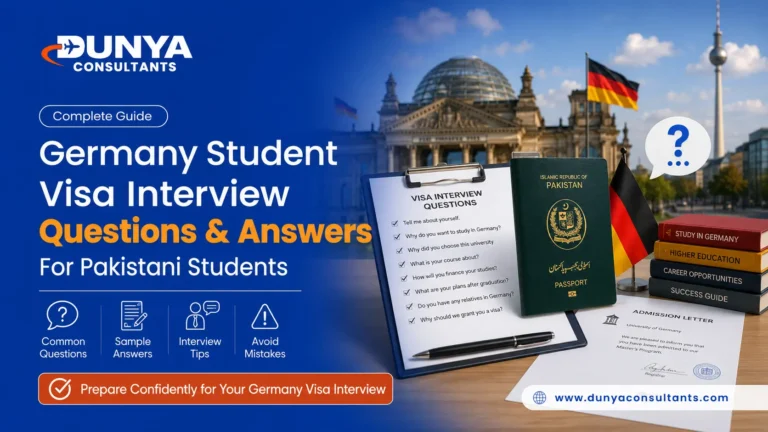

Preparing for Germany student visa interview questions is an important step for Pakistani students who want to study in Germany. The interview is not only about answering basic questions. It helps the visa officer understand your study plan, university choice, financial readiness, future goals, and genuine intention to study.
A strong Germany student visa interview is based on honest answers, clear documents, and confidence. Students should not memorise fake responses. Instead, they should understand their own application and explain their study plan in a simple and logical way.
This guide covers common Germany student visa interview questions and answers for Pakistani students, along with preparation tips and mistakes to avoid.
Why Germany Student Visa Interview Preparation Matters
Germany is one of the most popular study destinations for international students because of its high-quality education system, public universities, applied sciences universities, research opportunities, and career prospects. However, getting admission is only one part of the process.
Pakistani students also need to prove that they are genuine students, have sufficient financial resources, understand their selected course, and can explain why Germany is suitable for their academic and career goals.
Interview preparation helps students:
- Understand their own study plan
- Explain their course choice clearly
- Show financial readiness
- Avoid inconsistent answers
- Connect their past education with future goals
- Reduce unnecessary nervousness
- Present genuine study intentions
Students should also make sure their answers match their admission letter, CV, motivation letter, financial proof, and visa documents.
What Visa Officers Usually Check
Visa officers may ask questions to check whether the student’s application is genuine and consistent. The interview is usually focused on the student’s background, study purpose, selected university, course details, finances, and future plans.
They may check:
- Why you selected Germany
- Why you selected your course
- Why you selected your university
- Whether your academic background matches your course
- Whether you understand your study programme
- Whether your financial proof is clear
- Whether your answers match your documents
- Whether you plan to follow visa conditions
- Whether your future goals are realistic
Official guidance for studying in Germany explains that students generally need admission or a recognised study route, proof of financial resources, and health insurance for a study visa. These points often connect naturally with interview preparation.
Germany Student Visa Interview Questions and Answers
Below are common Germany student visa interview questions with sample answers. Students should use these as guidance, not as fixed scripts. Your real answer should match your own profile, university, course, finances, and future goals.
Questions About Germany
1. Why do you want to study in Germany?
Sample Answer:
I want to study in Germany because it has a strong education system, recognised universities, practical learning, and good research opportunities. Germany is also known for quality programmes in my field, and I believe studying there will help me build strong academic and professional skills.
2. Why did you choose Germany instead of another country?
Sample Answer:
I compared different study destinations and found Germany suitable because of its academic quality, international programmes, practical course structure, and strong industry connection. My selected programme in Germany matches my academic background and career goals better than other options.
3. What do you know about Germany?
Sample Answer:
Germany is located in Europe and is known for its strong economy, education system, technology, engineering, research, and innovation. It has many international students and offers a professional learning environment.
4. Do you know any German cities?
Sample Answer:
Yes, some major German cities are Berlin, Munich, Hamburg, Frankfurt, Cologne, Stuttgart, Leipzig, and Dresden. My university is located in [city name], and I have also researched its living cost and student environment.
Questions About Your University
5. Which university have you selected?
Sample Answer:
I have selected [University Name] for [Course Name]. I chose this university because the course structure, modules, teaching approach, and career relevance match my academic goals.
6. Why did you choose this university?
Sample Answer:
I chose this university because it offers the programme I want to study, and the course content is directly related to my previous education and future plans. I also checked the admission requirements, modules, location, and learning environment before applying.
7. Did you apply to any other universities?
Sample Answer:
Yes, I applied to [names if applicable]. I selected this university because it offered the most suitable course structure for my goals and gave me admission for the intake I planned.
8. Is your university public or private?
Sample Answer:
My university is [public/private]. I understand the tuition fee structure, semester contribution, and other costs related to my selected institution.
9. Where is your university located?
Sample Answer:
My university is located in [city name], Germany. I researched the city, living costs, accommodation options, transport system, and student life before finalising my decision.
Questions About Your Course
10. What course are you going to study?
Sample Answer:
I am going to study [Course Name]. This course is related to my previous education in [field] and will help me develop skills in [specific area].
11. Why did you choose this course?
Sample Answer:
I chose this course because it matches my academic background and career goals. The modules include [module names], which are relevant to the skills I want to develop for my future career.
12. What are the main modules in your course?
Sample Answer:
The main modules include [module 1], [module 2], [module 3], and [module 4]. These modules are important because they will help me gain knowledge in my selected field.
13. How is this course related to your previous studies?
Sample Answer:
My previous studies were in [field], and this course is a continuation of that area. It will help me improve my knowledge and specialise further in [specific field].
14. Why not study this course in Pakistan?
Sample Answer:
Although Pakistan has good institutions, I selected Germany because my chosen programme offers international exposure, practical learning, research-based education, and course modules that match my career direction.
Questions About Academic Background
15. What is your previous qualification?
Sample Answer:
My previous qualification is [degree/certificate name] from [institution name]. I completed it in [year] with [grade/CGPA if relevant].
16. What was your major subject?
Sample Answer:
My major subject was [subject name]. It is connected to my selected course in Germany because both focus on [connection between fields].
17. Do you have any study gap?
Sample Answer:
Yes, I have a study gap of [duration]. During this time, I was involved in [work, internship, language preparation, application process, or other genuine reason]. I can explain this with supporting documents if required.
18. Why are you changing your field?
Sample Answer:
I am changing my field because my career goals have shifted towards [new area]. I researched this course and found it suitable because it combines my previous knowledge with my future career direction.
Questions About Financial Proof and Blocked Account
19. Who is sponsoring your studies?
Sample Answer:
My studies are sponsored by [parents/self/sponsor name]. I have prepared financial documents to show that my tuition fee and living expenses can be managed during my stay in Germany.
20. Do you have a blocked account?
Sample Answer:
Yes, I have arranged a blocked account as financial proof for my living expenses in Germany. I have the confirmation document ready with my visa documents.
21. Why is financial proof important?
Sample Answer:
Financial proof is important because it shows that I can cover my living expenses and focus on my studies without financial difficulty.
22. What are your expected living expenses in Germany?
Sample Answer:
My expected living expenses include accommodation, food, health insurance, transport, study materials, and personal expenses. I have planned my budget according to my city and available financial proof.
23. Will you work during your studies?
Sample Answer:
My main priority will be my studies. If allowed under student visa conditions, I may work part-time to gain experience and support some personal expenses, but I will not depend completely on part-time income.
Official information for studying in Germany states that proof of financial resources can be shown through options such as a blocked account, scholarship, or Declaration of Commitment, depending on the case.
Questions About Health Insurance
24. Do you have health insurance?
Sample Answer:
Yes, I have arranged health insurance according to my visa and university requirements. I understand that health insurance is important for students in Germany.
25. Why do students need health insurance in Germany?
Sample Answer:
Students need health insurance because it is required for studying and living in Germany. It helps cover medical needs during the stay.
Questions About Future Plans
26. What are your plans after completing your studies?
Sample Answer:
After completing my studies, I plan to use my education and skills to build a professional career in my field. My long-term goal is to gain experience and contribute to my professional area.
27. Will you return to Pakistan after your studies?
Sample Answer:
My main purpose is to complete my studies successfully. After graduation, I will follow the legal options available to me and make a decision based on my career opportunities, family plans, and visa rules.
28. What career do you want after graduation?
Sample Answer:
I want to work as a [career role] in the field of [field]. This course will help me gain the technical and professional skills required for that career.
29. How will this course help your future?
Sample Answer:
This course will help me improve my knowledge, gain international exposure, and develop practical skills. It is directly connected to my future career goals.
Questions About Family and Ties to Pakistan
30. Do you have family in Pakistan?
Sample Answer:
Yes, my family lives in Pakistan. They support my study plan and are aware of my education goals.
31. Do you have relatives in Germany?
Sample Answer:
Yes/No. If yes, answer honestly and mention the relationship. If no, simply say that you do not have relatives in Germany.
32. What are your ties to Pakistan?
Sample Answer:
My family, personal responsibilities, academic background, and long-term connections are in Pakistan. My study plan is focused on gaining education and building a strong future.
Questions About Accommodation and Travel
33. Where will you live in Germany?
Sample Answer:
I plan to live in [student accommodation/private accommodation/temporary stay]. I have researched accommodation options near my university and understand the expected rent and location.
34. When do your classes start?
Sample Answer:
My classes start in [month/year or semester]. I plan to travel before the start date so I can complete enrolment, accommodation, and city registration steps.
35. Do you know about city registration after arrival?
Sample Answer:
Yes, after arrival in Germany, students usually need to register their address with the local authorities and complete university enrolment and residence permit steps.
Questions About Visa Refusal and Risk
36. What will you do if your visa is refused?
Sample Answer:
If my visa is refused, I will carefully review the reason, correct any issue, improve my documents if needed, and follow the proper legal or application process.
37. Why should we approve your visa?
Sample Answer:
My study plan is genuine, my documents are complete, I have admission from a recognised institution, I have arranged financial proof, and my course is connected to my academic and career goals.
Common Mistakes During Germany Visa Interview
Many students make mistakes because they are nervous or not prepared. Some students memorise answers without understanding their own application. This can create confusion if the officer asks follow-up questions.
Common mistakes include:
- Giving memorised answers
- Not knowing course modules
- Not knowing university location
- Weak explanation of why Germany
- Poor understanding of financial proof
- Giving answers that do not match documents
- Not explaining study gap clearly
- Overconfident or casual attitude
- Providing false information
- Not knowing future plans
- Confusing university names or course names
A good Germany student visa interview requires preparation, honesty, and consistency.
Tips to Answer Confidently
Students should prepare for Germany student visa interview questions before the appointment. However, preparation should be based on real understanding, not memorisation.
Useful tips:
- Read your admission letter carefully
- Learn your course modules
- Understand your university and city
- Review your financial documents
- Prepare your study gap explanation
- Match your answers with your CV and motivation letter
- Speak clearly and politely
- Keep answers short but complete
- Be honest if you do not know something
- Avoid fake or exaggerated claims
Final Germany Student Visa Interview Checklist
Before the interview, students should check:
- Admission letter is ready
- Passport is valid
- Visa documents are organised
- Blocked account confirmation is ready, if used
- Health insurance proof is ready
- CV and motivation letter are reviewed
- Course modules are understood
- University details are clear
- Financial sponsor details are clear
- Accommodation plan is ready
- Future goals are realistic
- Answers match all documents
Need Help Preparing for Your Germany Student Visa Interview?
Preparing for Germany student visa interview questions can feel stressful for many Pakistani students. The best way to prepare is to understand your application, review your documents, and practise honest answers.
Students should focus on clarity, confidence, and consistency. A strong interview is not about perfect English or memorised lines. It is about proving that your study plan is genuine and your documents support your application.
FAQs About Germany Student Visa Interview Questions
What are common Germany student visa interview questions?
Common questions include why you chose Germany, why you selected your university, what course you will study, who will sponsor your education, what your future plans are, and how your course connects with your previous studies.
Is Germany student visa interview difficult?
The interview is manageable if the student understands their study plan, documents, university, course, financial proof, and future goals. It becomes difficult when answers are memorised or inconsistent.
How should Pakistani students prepare for Germany visa interview?
Pakistani students should review their admission letter, course modules, university details, blocked account or financial proof, health insurance, CV, motivation letter, and future career goals.
Can Germany student visa be rejected after interview?
Yes, a visa can be refused if documents are incomplete, financial proof is weak, study intention is unclear, answers are inconsistent, or the student cannot explain the study plan properly.
Should I memorise Germany student visa interview answers?
No. Students should understand their own application and practise natural answers. Memorised answers can sound fake and may create problems if follow-up questions are asked.
What should I say if I do not know an answer?
Be honest and polite. It is better to say you are not sure than to give false information. However, students should research their course, university, city, and financial plan before the interview.
Does Germany require IELTS for student visa?
IELTS depends on the university and programme requirements. If the programme requires English language proof, IELTS or another accepted test may be needed.
Conclusion
Germany student visa interview questions are designed to check whether the student has a genuine study plan, clear academic direction, proper financial proof, and consistent documents.
Pakistani students should prepare early, understand their course and university, review their documents, and answer honestly. A confident interview depends on clarity, preparation, and consistency.