Studying in the United States is exciting, but the visa step can feel intimidating, especially if it’s your first international application. The truth is simple: most students get approved when their file is complete, their finances are clear, and their study plan makes sense.
At Dunya Consultants, we coach students to treat the US visa as a story that must stay consistent from start to finish. Your admission, your funding, and your plan should all point in one direction: you are a genuine student who will follow the rules.
This guide gives you a practical checklist, step-by-step process, and interview tips that match what the US student visa requirements guidance actually asks for.
What do you need for a US student visa?
You typically need: a valid passport, DS-160 confirmation, visa fee receipt (as applicable), your Form I-20 (or DS-2019 for J-1), and evidence of funding and intent to return after studies.
What is the most important document?
For F-1 and M-1, Form I-20 is essential because it confirms your SEVIS record and eligibility to apply for the visa.
How early should you apply?
US guidance recommends applying early, and you should follow your local US Embassy or Consulate instructions for appointment timelines.
Types of US student visas (choose the right one)
Most students fall into one of these categories:
- F-1 visa: academic programs and English language programs
- M-1 visa: vocational and technical programs
- J-1 visa: exchange visitor programs (research, internships, exchange study)
Your school or sponsor issues the main eligibility document:
- Form I-20 for F-1 and M-1
- Form DS-2019 for J-1
US student visa requirements you must meet
1) Acceptance at a SEVP-approved school
Your institution must be able to issue an I-20 through SEVIS.
2) Passport validity
Your passport must be valid for at least six months beyond your period of stay, unless your country is exempt by agreement.
3) SEVIS and the I-901 fee
F, M, and many J applicants pay the SEVIS I-901 fee using the official DHS fee website.
4) DS-160 form
You must complete the DS-160 online non-immigrant visa application and keep the confirmation page.
5) Proof of finances and intent to return
A consular officer may request evidence of how you will pay costs and your intent to depart after your studies.
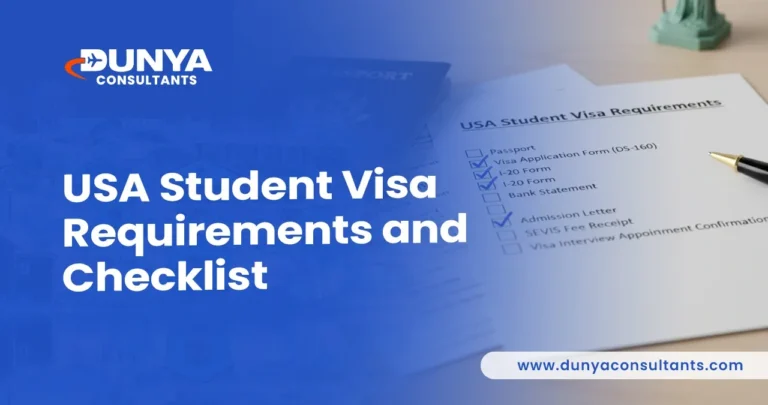
US student visa checklist (documents)
Use this as your interview folder checklist.
Required documents (common core)
- Passport
- DS-160 confirmation page
- Visa fee receipt (if required before the interview in your location)
- Photo (uploaded to DS-160; bring a printed one if upload fails)
- Form I-20 (F-1/M-1) signed by you and the school official
- SEVIS I-901 fee receipt
Strong supporting documents (often requested)
- Academic transcripts, diplomas, certificates
- Standardized test scores required by your school (if applicable)
- Proof of finances to cover tuition, living, travel costs
- A clear study plan (SOP style) explaining why this course and why now
- Proof of ties to home country (career plan, family responsibilities, property, business, ongoing commitments)
Helpful extras (not always required, but can strengthen clarity)
- Scholarship letter or sponsor letter (if applicable)
- Proof of accommodation plan (initial plan is fine)
- Resume/CV
- Any assistantship details or funding confirmation
Step-by-step process (simple and reliable)
Step 1: Get admitted and request your I-20 or DS-2019
Your school issues an I-20 after they enter your data in SEVIS.
Step 2: Pay the SEVIS I-901 fee
Pay through the official portal and print the receipt.
Step 3: Complete DS-160
Fill it carefully and save the confirmation page.
Step 4: Schedule the interview at your US Embassy/Consulate
Follow the instructions for your specific location.
Step 5: Attend the interview and submit biometrics as required
Fingerprinting is commonly taken during the interview, depending on the location.
Step 6: If needed, respond to administrative processing or document requests
Sometimes cases require additional processing after the interview.
Step 7: After approval, plan travel correctly
Students on F or M visas generally cannot enter the US more than 30 days before the program start date on the I-20.
Financial proof (what works best)
Avoid guessing a “required bank balance.” The safe approach is this:
- Use the cost of attendance shown on your I-20 (tuition + living estimate)
- Show funds that clearly cover that amount
- Make the source traceable (salary, business income, savings history, education loan, scholarship)
US guidance notes that the officer may ask for evidence of how you will pay educational, living, and travel costs.
Tip from our team: add a one-page financial summary that totals your funds and explains where they come from, in plain language.
Interview tips that actually help
Think like the officer
They are assessing whether you qualify under US law and whether you intend to depart after a temporary stay.
Your best interview answers are:
- Short and direct
- Consistent with your documents
- Specific to your course and why that university
- Clear on who is funding you and how
How to show “ties” without sounding scripted?
US guidance explains that ties vary and examples include your job, home, and relationships with family and friends.
So talk about your real life: your family responsibilities, career pathway back home, business plans, or existing employment goals.
Can you work while studying on an F-1 visa?
Many F-1 students can work on-campus up to 20 hours per week while school is in session, and more during breaks if eligible. Rules can vary by authorization type, so always confirm with your Designated School Official (DSO).
Common mistakes to avoid
- Submitting incomplete forms or missing documents (a common cause of 221(g) refusals)
- Showing funds that do not match the I-20 cost estimate, or unexplained deposits
- Rehearsed answers that conflict with your file
- Not knowing basic facts: program name, duration, tuition, funding source
- Booking travel before a decision (US guidance warns against final travel plans until a visa is issued)
If your visa is refused, what next?
Two common outcomes:
- 221(g): missing documents or administrative processing, you may be asked to submit more info
- 214(b): You did not sufficiently demonstrate eligibility or overcome immigrant intent. You can reapply if circumstances or evidence change
If refused, focus on fixing the exact weakness, then reapply with a stronger and clearer file.
Conclusion
A US student visa is not about perfect English or lucky interviews. It’s about a clean file, a believable study plan, and funding that makes sense on paper.
If you want a second set of eyes, the Dunya Consultants team can review your I-20, financial summary, and interview preparation so your application feels consistent and confident from start to finish.
FAQs
What documents are required for an F-1 visa interview?
Common required documents include your passport, DS-160 confirmation, visa fee receipt (as applicable), Form I-20, and supporting evidence that the officer may request, like academics and financial proof.
What is Form I-20 and why does it matter?
Form I-20 confirms your SEVIS record and eligibility to apply for an F-1 or M-1 visa. You and your school official must sign it.
How much money do I need to show for a US student visa?
There is no single fixed number. You should show funds that cover the amount listed on your I-20 (tuition + living expenses) with a clear and traceable source.
How early can I enter the US on an F-1 visa?
Students on F or M visas are generally not permitted to enter more than 30 days before the program start date.
Can I work in the US on an F-1 visa?
On-campus work is commonly allowed up to 20 hours per week while school is in session, subject to F-1 rules and DSO guidance.
What should I do if my visa is refused?
Read the refusal basis (often 221(g) for missing items or 214(b) for eligibility/intent). Fix the specific gap and reapply with stronger evidence.