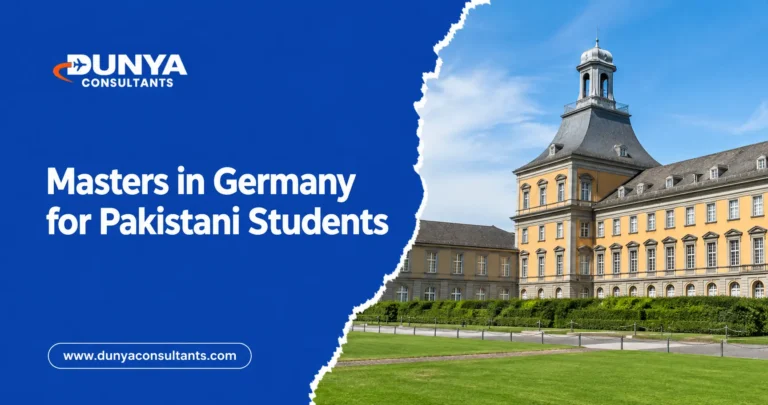
Masters in Germany for Pakistani students can be a strong option for graduates who want to continue their education in Europe without facing extremely high tuition costs. Germany has a large higher education system and offers Master’s programmes in computer science, engineering, business, data science, artificial intelligence, biotechnology, finance and many other fields. A good number of programmes are also taught in English, which makes Germany easier to consider for students who are not yet fluent in German.
The cost of education is another reason Germany attracts Pakistani students. Many public universities offer Master’s programmes without a large standard tuition fee, although this does not mean the whole study experience is free. Semester contributions, accommodation, health insurance, food, transport and personal expenses still need to be included in the budget. Some universities and programmes may also charge tuition, while private universities generally have higher fees.
For students planning masters in Germany for Pakistani students, the main challenge is usually not finding universities. It is finding programmes that actually match their previous education. German universities often look closely at your Bachelor’s degree, transcript, completed subjects and academic background before making an admission decision, so a careful shortlist matters much more than applying everywhere.
Why Masters in Germany for Pakistani Students Can Be a Good Option
For graduates looking at postgraduate study in Europe, masters in Germany for Pakistani students can offer a good balance between programme choice, academic quality and manageable study costs. Germany has traditional universities, technical universities and universities of applied sciences, which gives students different options depending on whether they want a research-focused, technical or more practical programme.
Master’s degrees are available in a wide range of fields. Students with backgrounds in Computer Science, Software Engineering, IT, Mechanical Engineering, Electrical Engineering, Civil Engineering, Business, Finance and natural sciences can usually find related programmes to explore. The important point is to choose a course that fits your previous education rather than simply picking a university because its name is well known.
English-taught programmes also make Germany more practical for international students. Many postgraduate programmes, especially in technology, science, engineering and business, are available in English. German can still be useful for daily life, student jobs and future employment, but students do not always need to be fluent before applying to an English-taught programme.
Can Pakistani Students Apply for a Master’s in Germany?
Yes, Pakistani students can apply for Master’s programmes in Germany if they meet the academic and language requirements of the chosen university. There is no single admission rule used by every German institution, so eligibility has to be checked programme by programme.
Eligibility for masters in Germany for Pakistani students depends mainly on the applicant’s Bachelor’s degree, previous subjects, grades and the requirements of the chosen programme. One course may accept students from several related academic backgrounds, while another may require a very specific degree and certain previous modules.
For example, a student with a BS Computer Science may be suitable for a Master’s in Data Science, but the university may still want to see previous study in mathematics, statistics, programming or algorithms. In engineering, the university may check whether you completed enough coursework in the relevant engineering discipline before considering your application. This is why the name of your Bachelor’s degree alone is not always enough; the transcript can be just as important.
Basic Eligibility Requirements for a Master’s in Germany
A recognised Bachelor’s degree is normally the starting requirement for postgraduate admission. Pakistani students commonly apply after completing a four-year BS or another relevant undergraduate qualification. The university then checks whether that degree is suitable for the Master’s programme and whether the academic content matches what the course expects.
Academic performance also matters, but there is no one CGPA that guarantees admission across Germany. Some programmes have a clearly stated minimum grade, while others assess the overall profile. A student may therefore qualify for one university but not another even with the same academic record.
Subject relevance is often just as important as grades. A student applying for Artificial Intelligence may need previous study in programming and mathematics, while an engineering programme may require credits in specific technical subjects. For masters in Germany for Pakistani students, reviewing your transcript before making a university list is one of the most useful things you can do.
Do You Need IELTS for a Master’s in Germany?
Language requirements for masters in Germany for Pakistani students are not the same at every university. For English-taught programmes, universities commonly ask for recognised proof of English proficiency, and IELTS Academic and TOEFL are among the most common options.
Some institutions may also accept Cambridge English qualifications or another approved form of English proof. The required score depends on the programme. One course may accept a moderate score, while another may expect a stronger level because the degree involves advanced academic reading, writing and presentations.
Some universities may consider previous education completed in English, but a Medium of Instruction letter is not a standard replacement for IELTS across Germany. Students should only rely on MOI if the university clearly states that it is acceptable.
What If the Programme Is Taught in German?
Students applying for a German-taught Master’s normally need to prove German-language ability. The required level and accepted certificates can vary between universities, so the language requirement needs to be checked before applying.
An English-language test does not replace the German requirement for a programme taught in German. If you do not yet have strong German, focusing on English-taught programmes may be more practical.
Even for an English-taught degree, learning some German can still be useful. It can make everyday life easier and can also help later when looking for internships, student jobs or full-time employment.
Popular Master’s Subjects in Germany
There are many subject options available for masters in Germany for Pakistani students, particularly in technology, engineering, business and science-related fields. Students often explore Computer Science, Information Technology, Cyber Security, Artificial Intelligence, Data Science, Software Engineering, Mechanical Engineering, Electrical Engineering, Civil Engineering, Renewable Energy, Business Administration, Finance, Economics, Biotechnology and Environmental Science.
The right subject depends on your Bachelor’s degree. A student with a technical background may have several related options, while a student trying to move into a completely different academic field can face more restrictions.
German universities often expect Master’s applicants to already have a foundation in the subject they want to continue studying. That is why programme selection should begin with your previous academic background rather than only with career trends.
Public Universities in Germany
Public universities are often the first choice for masters in Germany for Pakistani students because many programmes have relatively low study costs compared with private institutions. A number of public Master’s programmes do not charge a large standard tuition fee, although students usually still pay a semester contribution.
This semester contribution can cover administrative costs and, depending on the university, other student services. However, public does not always mean tuition-free. Some universities, programmes or regions may charge tuition, so students should check the actual fee information before applying.
The programme itself matters more than the label of public or private. A public university may be affordable but still not be suitable if the academic requirements do not match your background.
Private Universities in Germany
Private universities usually charge tuition fees, and the amount can vary significantly depending on the institution and course. Some private universities may offer specialised programmes, different intake options or admission routes that suit certain students better.
A private university is not automatically a bad option. It simply needs to make sense for your academic profile and budget. Students should compare the complete cost, course content and admission conditions rather than making the decision only on the basis of whether the university is public or private.
For some students, a private university may offer a programme that fits their goals better. For others, a public option may be the more practical choice.
Is a Master’s in Germany Free for Pakistani Students?
The word “free” can be misleading. Many students searching for masters in Germany for Pakistani students come across claims about free education, but in many cases this refers to public programmes where there is no large standard tuition fee.
Students still need money for semester contributions, accommodation, health insurance, food, transport, study materials and personal expenses. Some programmes also charge tuition, so the full cost must always be checked.
Germany can therefore be an affordable option compared with several other study destinations, but students should not plan as though the entire degree and living cost will be free.
How Much Does a Master’s in Germany Cost?
The overall cost of masters in Germany for Pakistani students depends on tuition, semester contributions, accommodation and the city where the student lives. A student at a public university without standard tuition will usually have a very different budget from someone studying at a private institution.
Living costs also vary by city, and accommodation is often the largest monthly expense. As a general planning range, many students budget around €900 to €1,200 per month, although actual spending can be lower or higher depending on location and lifestyle.
This is why it is better to compare the total yearly cost rather than only the tuition fee. A low-tuition programme in an expensive city may still require a larger budget than another course in a more affordable location.
Financial Proof for a German Student Visa
Pakistani students applying for a German student visa normally need to show that they can support themselves during their studies. A blocked account is one common way of providing financial proof, while other recognised options may also be possible depending on the applicant’s situation.
A qualifying scholarship or a formal Declaration of Commitment may also be relevant in some cases. The important point is that financial proof should be prepared according to the current visa requirements that apply to the student.
Students should also remember that visa financial proof is not always the same as the full study budget. There can be extra expenses before travel, including flights, accommodation deposits, semester charges and initial living costs.

Documents Needed for a Master’s Application
The exact list depends on the university, but Pakistani students commonly prepare a Bachelor’s degree or provisional certificate, academic transcripts, passport, English or German language proof, CV, motivation letter where required, and any additional programme-specific documents.
Some universities may also ask for detailed course descriptions or module information from your Bachelor’s degree. This helps them decide whether your previous education matches the Master’s programme closely enough.
It is better to check each programme separately instead of preparing one generic application package and sending it everywhere. Different universities may ask for different documents even when the degree title looks similar.
Do Pakistani Students Need APS?
Pakistani students should not assume that APS is automatically required for every university or visa application. Requirements can vary depending on the applicant category, university and the current checklist being followed.
If APS is specifically requested in your case, then it should be provided. If it is not part of the relevant requirement list, students should not add it simply because they have seen it mentioned for applicants from another country.
The safest approach is to follow the exact instructions provided for your own university and visa application.
How to Choose the Right Master’s Programme
Applications for masters in Germany for Pakistani students should begin with a careful review of academic eligibility rather than simply applying to famous universities. Start with your Bachelor’s transcript and look at the major subjects you completed.
Then search for Master’s programmes that build naturally on that background. Once you find a relevant course, check the academic requirements, language condition, tuition, semester contribution, city, intake and deadline.
Programme modules are also worth reviewing because two courses with similar names can have very different content. A smaller shortlist of well-matched programmes is usually more useful than a long list of random applications.
How to Apply for Masters in Germany for Pakistani Students
The application process is not the same at every university. Some institutions accept applications directly through their own portal, while others use a separate application system.
The usual process begins with choosing the right subject and checking whether your Bachelor’s degree matches the programme. After that, students review the language requirement, prepare the required documents, complete any necessary language test and submit the application through the route mentioned by the university.
Students should also check deadlines individually because two universities offering similar programmes may have completely different application dates. Once an admission offer is received, financial arrangements and visa preparation become the next major steps.
When Should Pakistani Students Apply?
Germany generally has winter and summer semesters, although not every Master’s programme offers admission in both. Some courses have only one intake each year, and deadlines can also be different for international applicants.
Students should begin research several months before the intended intake. Language tests, transcripts, document preparation and programme comparison can all take time, and waiting until the last few weeks often leads to rushed applications.
Starting early also gives you time to replace unsuitable universities with better options if you discover that a programme does not match your academic background.
Is Study Gap Accepted for a Master’s in Germany?
A study gap does not automatically prevent masters in Germany for Pakistani students. There is no universal German rule stating that every university accepts a fixed number of gap years.
Universities usually consider the applicant’s academic background and whether the programme requirements are met. Relevant work experience can also help explain the gap, especially if it connects with the intended Master’s degree.
Students should avoid depending on statements such as “Germany accepts five years” or “ten years are always accepted.” The situation is generally reviewed according to the individual programme and applicant profile.
Can International Students Work During Their Master’s?
International students can work while studying under the applicable German student work rules. Part-time work can help with some personal expenses and can also provide useful professional experience.
Students in IT, engineering, business or research-related fields may eventually find positions connected to their studies. However, it is not sensible to depend completely on part-time income when planning your budget.
Finding suitable work can take time, and German-language ability can affect the number of jobs available. Your basic financial plan should still make sense even if you do not find a job immediately.
Career Opportunities After a Master’s
Completing masters in Germany for Pakistani students can provide international academic experience and an opportunity to build professional skills before entering the job market. Career options depend heavily on the subject studied and the skills developed during the degree.
Computer Science graduates may move towards software, data, cloud technology or cyber security. Engineering graduates may explore manufacturing, automation, energy or technical roles, while business students may look at finance, management, marketing or consulting.
A Master’s degree alone does not guarantee employment. Internships, practical projects, language ability and professional networking can all make a difference, especially for students who want to stay in Germany after graduation.
Does University Ranking Matter?
Ranking can be useful, but it should not be the first filter when choosing a programme. A highly ranked university may offer a course that does not match your Bachelor’s subjects, while another institution may have a programme that fits your profile much better.
Students should look at programme modules, research areas, specialisations, admission requirements, location and practical opportunities. A suitable course at the right university can be more valuable than choosing a famous name without checking the actual programme.
For a Master’s degree, course relevance should come before reputation alone.
Common Mistakes Pakistani Students Should Avoid
A common mistake is applying to programmes only because the degree title looks relevant. German universities may examine your previous subjects closely, so students should check academic requirements before submitting an application.
Another mistake is focusing only on tuition and ignoring living expenses. A low-cost university in an expensive city can still require a large overall budget. Students also sometimes assume every English-taught programme accepts the same language test or the same IELTS score, which is not true.
Leaving documents, language tests and shortlisting until the last minute is another avoidable problem. A well-prepared application usually starts much earlier.
How Dunya Consultants Can Help
Dunya Consultants can help students planning masters in Germany for Pakistani students compare programmes according to their previous education, budget and preferred intake. The process can begin with a review of the student’s Bachelor’s degree, transcript, intended subject and financial plan.
From there, suitable programmes can be shortlisted based on their actual admission requirements. This helps students avoid spending time on applications that do not match their academic background.
Support can also include application preparation, document review, financial planning and general student visa guidance. The aim should be to build a realistic application plan rather than simply submitting the highest possible number of applications.
Is Masters in Germany for Pakistani Students Worth Considering?
For the right student, masters in Germany for Pakistani students can offer a strong combination of university choice, English-taught study and comparatively affordable public education.
The decision should still be based on more than tuition. Students should check whether their Bachelor’s degree matches the course, whether they can meet the language requirement and whether they can manage the complete cost of studying and living in Germany.
If these points make sense, Germany can be a practical destination for postgraduate study and a strong option for students who want both academic and professional exposure.
Final Thoughts
A successful plan for masters in Germany for Pakistani students starts with choosing programmes that genuinely match the student’s Bachelor’s degree and long-term goals. Germany has many universities and a wide range of Master’s programmes, but every course can have different requirements.
Students should compare academic eligibility, language conditions, tuition, semester charges, city and application deadlines before deciding where to apply. A realistic shortlist is far more valuable than applying to every university you find.
The best university list is not the longest one. It is the one where each programme has a clear reason to be included.
Frequently Asked Questions
Can Pakistani students apply for a Master’s in Germany?
Yes. Pakistani students can apply if they meet the academic, language and programme-specific requirements of the university.
Is a Master’s in Germany free?
Many public universities offer some Master’s programmes without large standard tuition fees, but semester contributions and living expenses still apply. Some programmes may also charge tuition.
What CGPA is required for a Master’s in Germany?
There is no single CGPA requirement for every German university. Each programme sets its own criteria and may also check relevant subjects completed during the Bachelor’s degree.
Is IELTS compulsory?
Not for every programme. Universities may accept IELTS, TOEFL and Cambridge English or another approved form of language proof, depending on their own requirements.
Can Pakistani students use an MOI letter?
Some universities may accept previous English-medium education or an MOI letter, but this is not a general rule across Germany.
Is study gap accepted?
There is no universal fixed gap limit. Universities usually assess the applicant’s academic and professional background according to the programme.
Can students work while studying?
Yes. Eligible international students can work during their studies according to the applicable German student work rules.
Can I change my field for a Master’s?
Sometimes, but many programmes require a related Bachelor’s degree and specific previous subjects. A major change of field can therefore reduce the number of suitable options.
Are English-taught Master’s programmes available?
Yes. Germany has many English-taught postgraduate programmes, particularly in technology, engineering, science and business-related subjects.
Should I choose a public or private university?
That depends on your academic profile, programme requirements and budget. Public universities are usually more affordable, while private institutions may offer different courses, intakes and admission options.